Typical Portion Sizes and Daily Energy Contribution
Educational content on nutrient characteristics. No promises of outcomes.
Introduction
Breakfast portion sizes vary across UK households and individuals, reflecting personal preference, time availability, appetite, and cultural context. This article explores typical UK breakfast portion norms and contextualises breakfast energy contribution relative to total daily energy requirements.
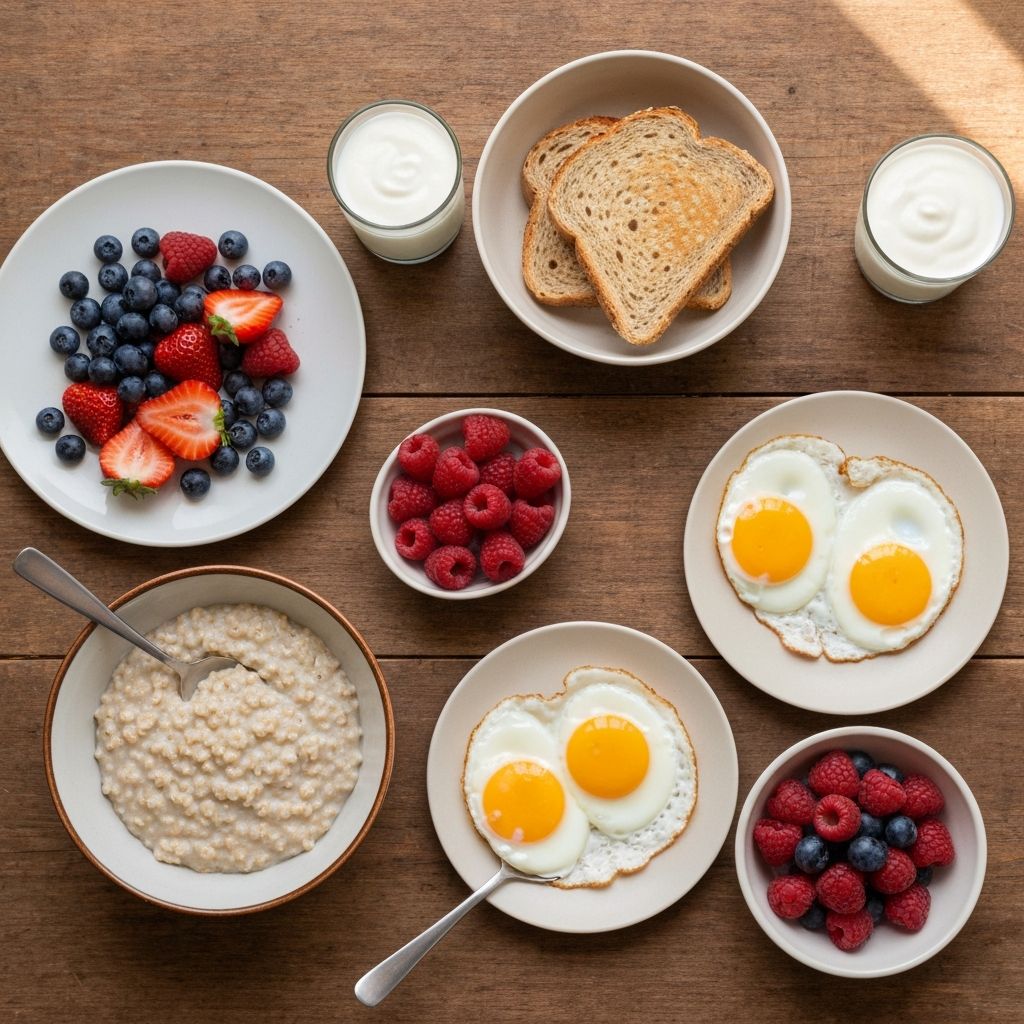
Standard Portion Measurements
Common breakfast items have recognisable standard portion sizes based on household practice:
Rolled Oats
- Typical portion (dry weight): 40 grams
- Cooked portion (with water): approximately 200 to 250 grams
- Energy content: approximately 150 kilocalories
- Context: A breakfast bowl serving
Eggs
- Typical portion: 2 medium eggs
- Weight: approximately 100 grams
- Energy content: approximately 156 kilocalories
- Context: Boiled, poached, or scrambled
Wholegrain Toast
- Typical portion: 1 to 2 slices
- Weight per slice: approximately 30 grams
- Energy content per slice: approximately 80 kilocalories
- Context: Often paired with butter, avocado, or smoked salmon
Plain Greek Yoghurt
- Typical portion: 150 to 200 grams
- Energy content (150g): approximately 100 kilocalories
- Context: Served in a bowl, often with berries or granola
Fresh Berries
- Typical portion: 150 grams (approximately a handful)
- Energy content: approximately 60 kilocalories
- Context: Added to yoghurt, porridge, or consumed alone
Smoked Salmon
- Typical portion: 50 to 100 grams
- Energy content (100g): approximately 208 kilocalories
- Context: Served on wholegrain or rye bread, often with cream cheese or butter
Nuts and Seeds
- Typical portion (almonds): small handful (30 grams)
- Typical portion (seeds): 1 tablespoon (15 grams)
- Energy content (30g almonds): approximately 164 kilocalories
- Energy content (15g seeds): approximately 50 to 80 kilocalories
- Context: Added to yoghurt, porridge, or bread
Typical Breakfast Compositions and Energy Contribution
Example 1: Oatmeal-Based Breakfast
- 40 grams rolled oats (cooked): 150 kcal
- 150 grams berries: 60 kcal
- 1 tablespoon seeds: 50 kcal
- Total: 260 kilocalories
Example 2: Traditional Eggs and Toast Breakfast
- 2 medium eggs: 156 kcal
- 2 slices wholegrain toast: 160 kcal
- 1 teaspoon butter: 36 kcal
- Total: 352 kilocalories
Example 3: Yoghurt and Fruit Breakfast
- 150 grams plain Greek yoghurt: 100 kcal
- 150 grams mixed berries: 60 kcal
- 30 grams granola: 120 kcal
- Total: 280 kilocalories
Example 4: Salmon and Toast Breakfast
- 100 grams smoked salmon: 208 kcal
- 2 slices rye bread: 160 kcal
- 1 tablespoon cream cheese: 50 kcal
- Total: 418 kilocalories
Example 5: Light Breakfast (Tea and Toast)
- 1 slice wholegrain toast: 80 kcal
- 1 teaspoon butter: 36 kcal
- Total: 116 kilocalories
Breakfast as a Proportion of Daily Energy
Daily energy requirements vary based on age, sex, body composition, activity level, and metabolic factors. An average adult female may require approximately 1,800 to 2,000 kilocalories daily; an average adult male may require 2,200 to 2,500 kilocalories daily. These estimates are highly variable and subject to individual circumstances.
Breakfast contributions to total daily energy vary widely:
- Light breakfast (100 to 200 kcal): represents approximately 5% to 11% of estimated daily energy for an average adult
- Moderate breakfast (250 to 400 kcal): represents approximately 12% to 20% of estimated daily energy
- Substantial breakfast (400 to 600 kcal): represents approximately 20% to 33% of estimated daily energy
The proportion varies based on individual daily energy requirements and personal breakfast preference.
Variability in Breakfast Portion Practice
UK breakfast portions reflect multiple influences:
- Time availability: Rushed mornings may result in minimal or absent breakfasts; leisurely mornings may accommodate more substantial meals
- Appetite and hunger signals: Morning appetite varies individually, influenced by sleep timing, prior day's eating, and chronotype
- Work schedule: Those working early shifts may consume minimal breakfast; those starting work later may consume substantial breakfasts
- Cultural and family background: Breakfast traditions vary across cultures and families
- Food preferences: Individual food likes and dislikes shape breakfast composition
- Cost and accessibility: Available budget and proximity to food options influence breakfast choices
Breakfast Skipping and Pattern Variability
A subset of UK population skips breakfast regularly, consuming food only later in the morning or at midday. Individual responses to breakfast omission vary:
- Some individuals experience delayed hunger and maintain consistent energy and focus until late morning
- Some individuals experience increased hunger mid-morning, leading to snacking or substantial mid-morning meals
- Some individuals report difficulty concentrating without morning food intake
Individual responses to breakfast timing and composition vary widely; no universal breakfast pattern applies equally across all people.
Portion Norms and Individual Variation
Standard portion measurements represent typical household practice but do not prescribe universally appropriate quantities. Some individuals regularly consume breakfast portions smaller than the examples provided; others regularly consume substantially larger portions. Individual appetite, energy requirements, and preference determine everyday portion sizes.
Conclusion
Typical UK breakfast portions vary from light (100 to 200 kilocalories) to substantial (400 to 600 kilocalories), with moderate breakfasts in the 250 to 400 kilocalorie range representing a common middle ground. Breakfast energy contributions to daily total range from 5% to 33% of estimated daily requirements, depending on breakfast size and individual energy needs. Breakfast portion norms reflect household practice and individual preference rather than prescriptive standards.